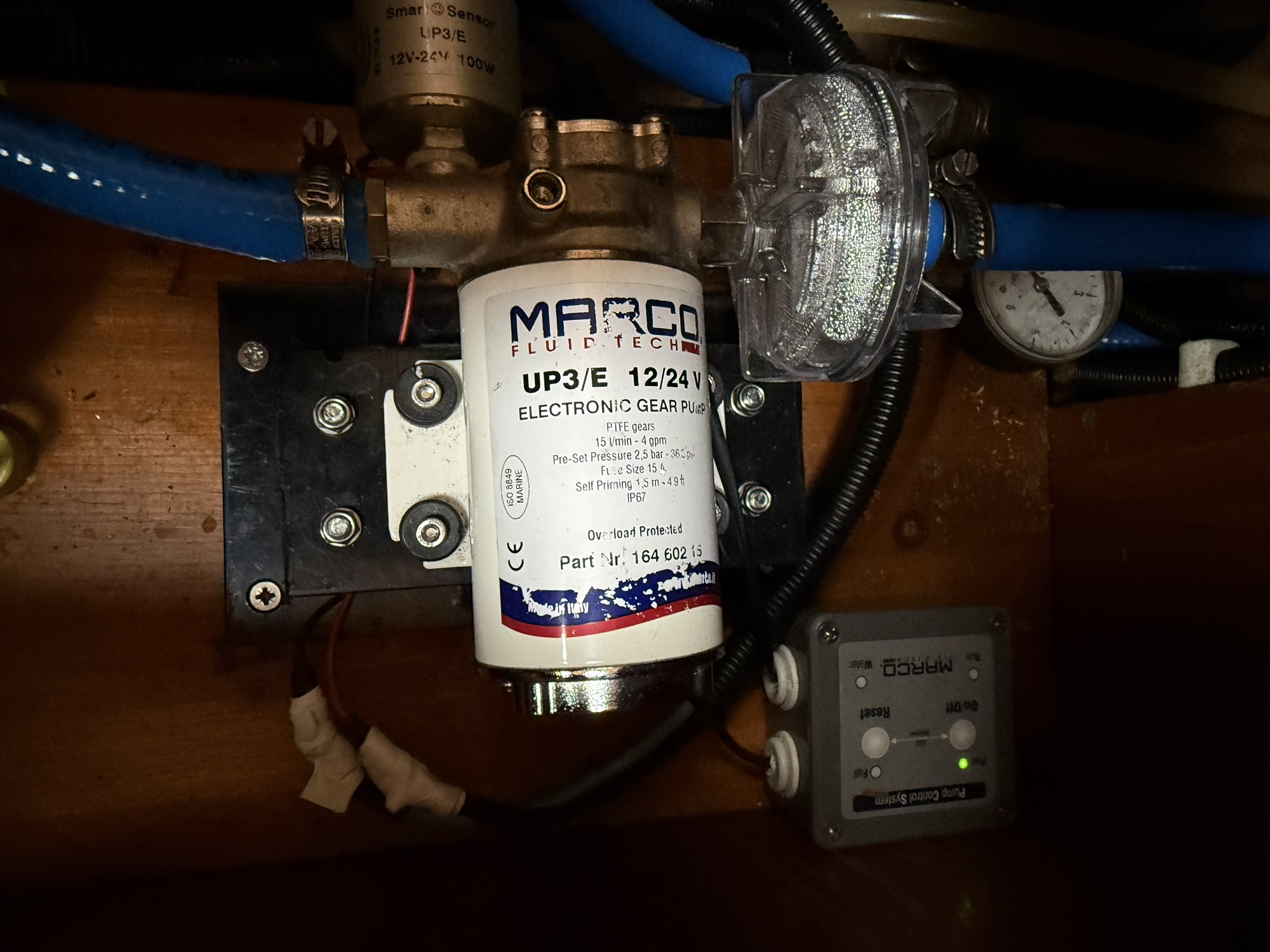
One of the spring jobs that I’d not written up but what has made a huge difference is some work on our freshwater pump. We have a Marco UP3/e gear based pump. It’s excellent and varies it’s speed to match the flow demand. I’d hoped it would self prime, but in our installation it doesn’t and needs a knurled bleed screw opening for a moment when we change tanks.
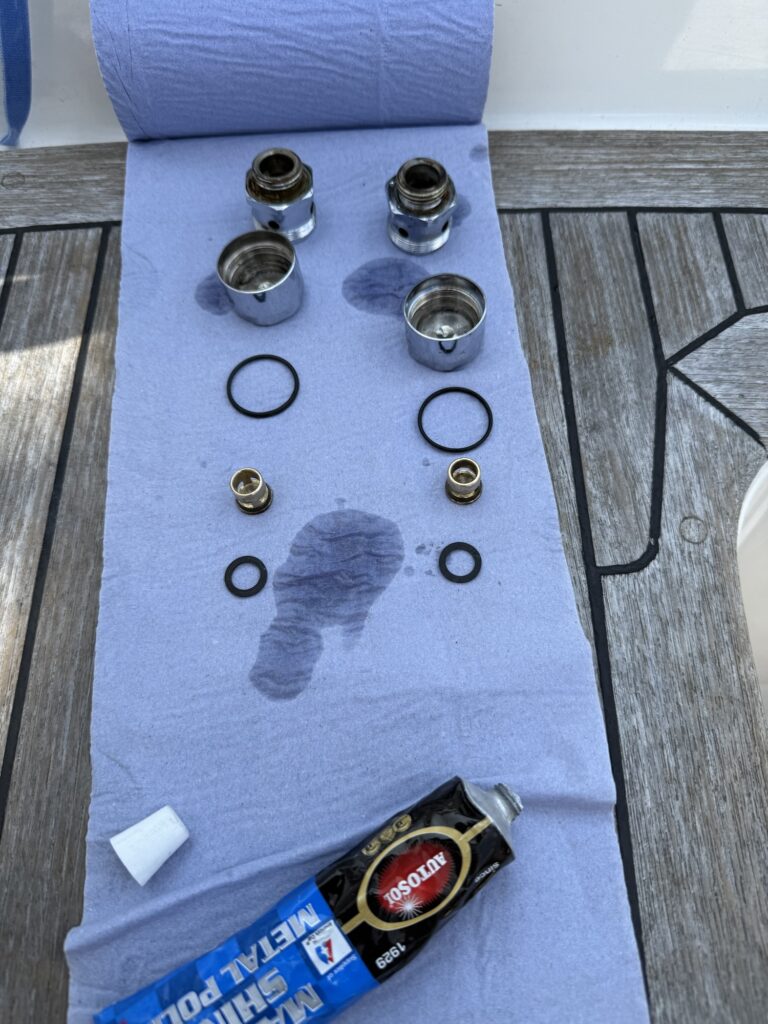
After six or more years use the need to prime it had increased and it might struggle to empty the tanks. That was partly due to some deposits on the valves on the breather lines, but stripping and polishing those in May 2025 didn’t entirely resolve the issue.
Cleaning and polishing the breather valves
This spring I bought a service kit for the pump – essentially two new helical gears, an O ring and new face plate. It was pretty trivial to install – though the gotcha is not to tighten the faceplate too hard, as over compressing the seal presses on the end face of the gears and prevents them from turning.
The pump had always been rather noisy with a high pitched whine. It was it’s Achille’s heel for us: I love the robust, durable pump, and variable flow but the noise was an irritant. It didn’t help that the pump was mounted to a shelf inside a locker under the saloon sofa that acted as a sounding board amplifying the noise.
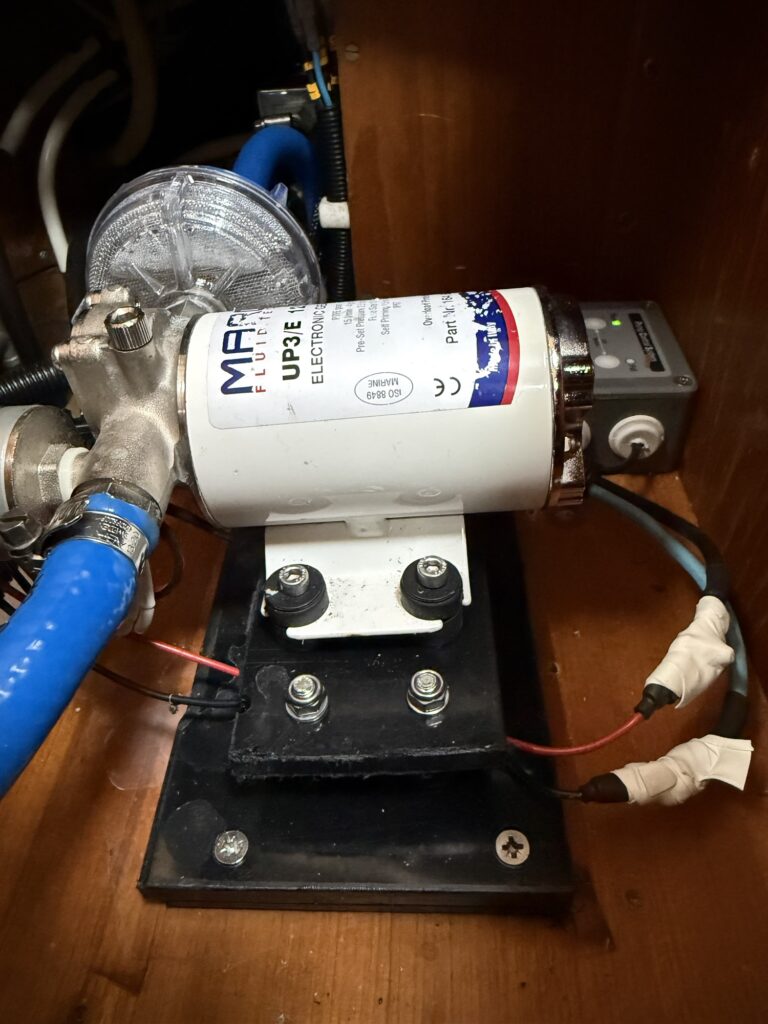
This spring I pointed my AI agent of choice, Perplexity, at the problem and it came back with a pile of sensible suggestions about installing the pump on a noise isolating raft. £10, including postage, got me four rubber mounting bushes, each with an M4 thread protruding on both sides. I used them to fix an 8mm offcut of HDPE sheet floating above another that with some spacers under it could be fixed to the original shelf, whilst the pump was mounted to the floating raft, plumbed in with flexible hose.
The noise isolated raft and pump.
It was a huge success. The noise levels dropped dramatically. Still audible but there was no longer a need to raise your voice or wait till it stopped.
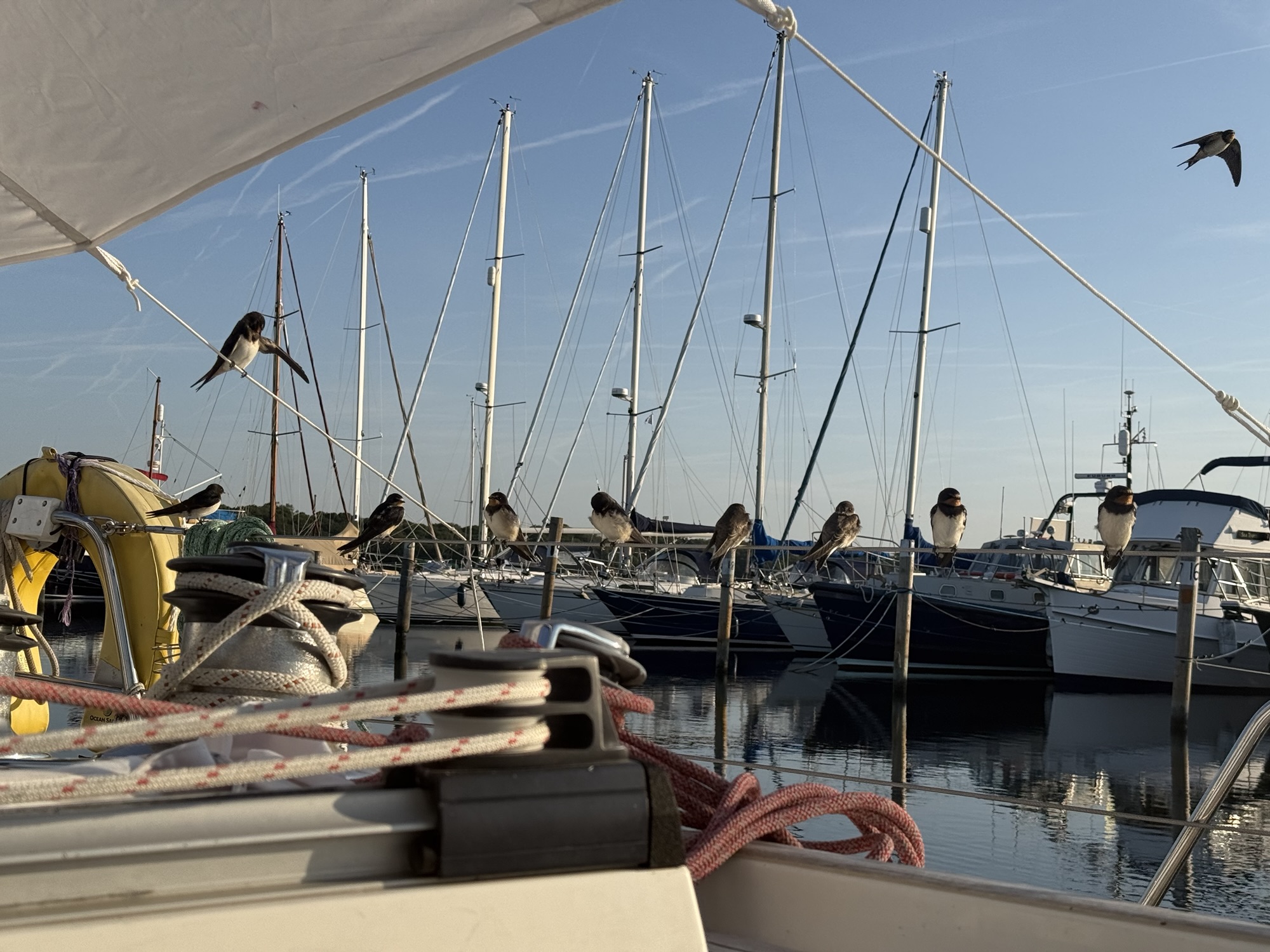
The start of our summer trip has been a bit leisurely: I’ve been slowly recovering from having been ill for most of July, so we’ve been taking it slowly. On the first Sunday morning, whilst still in Birdham, we were awoken by a lot of Swallow song. I got up to put the kettle on and was somewhat taken aback to meet a swallow in the saloon, who’d just flown in via the foredeck hatch. He (it was foolhardy enough for me to assume it was male) saw me, and gently turned and retreated back to the forepeak and back out of the hatch.
Foredeck hatch view
When he, or one of his friends, returned I had my phone ready.
Swallow investigating the forepeak
One of the morning tasks was cleaning the deck. To be fair to the swallows they weren’t really the culprit. The Starlings that had been gorging on blackberries and then perching in large numbers on our mast head were much more of a (messy) issue.
We spent the first full week of July trying to hide from the heat in London on the boat. Sunday 5/7 saw us leave Birdham for the Beaulieu river, where we exercised our RCC membership perk of a free mooring in the river. We stayed a couple of nights and on the Monday night took the tender ashore at the Royal Southampton Yacht Club’s Gin’s Farm landing for a nice walk ashore where we got to watch some farm workers rounding up cattle in the marsh, in order to put ear tags on the newest calves.
We were both working, courtesy of the Starlink, so could only move the boat outside office hours, meaning that it was late afternoon on Tuesday when we were able to sneak across the Solent, towing the tender, to anchor in Newtown Creek, where we spent a further couple of nights. We found that our solar array offset most of our daytime power consumption and even charged the batteries a bit, so we had no concerns about power all week, which is areal vindication of the system.
Anchored in Newtown
I’d been struggling for a while with what turned out to be a return of the Post Viral Fatigue that has plagued me since I had Covid quite badly in 2020, and a secondary infection that was affecting my ears. The idea had been to have a gentle week and rest up to recover, but by the end of the week I was no longer in a fit state to work. We headed back to Buckler’s Hard for Thursday evening, and spent the nigh in the Marina, filling the near empty water tanks (turns out we use about 40l/head/day when eating and showering aboard) and taking the opportunity to fill with diesel on Friday morning, after I’d had a teams call with my consultant.
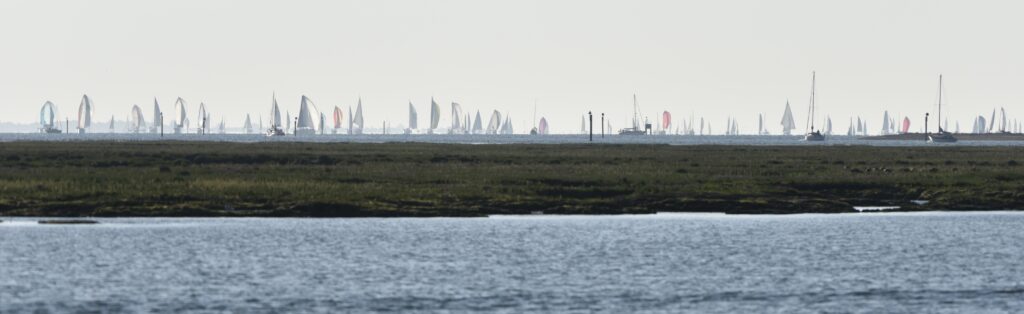
We spent Friday night back on a mooring down river and saw the start of the Round the Island Race pass the Beaulieu river on Saturday morning.
RTI Start
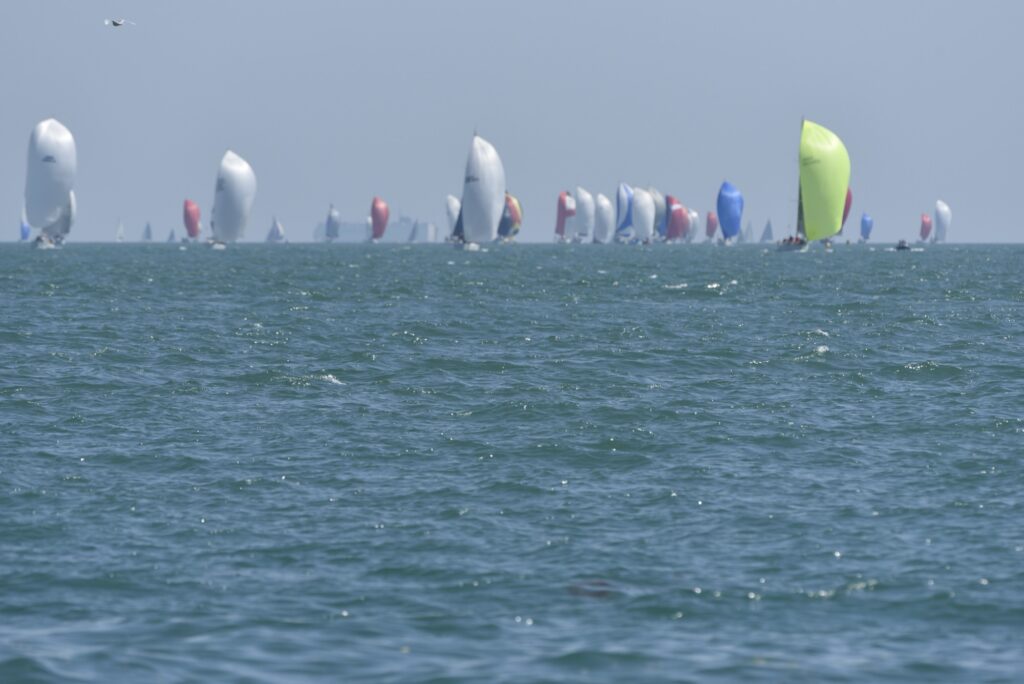
We headed home on Saturday, passing the returning RTI fleet off Bembridge.
RTI off Bembridge
We paused briefly in the Thorney Channel, but decided that the increasing forecast made it more sensible to lock back into Birdham that evening, and returning to London in the morning.
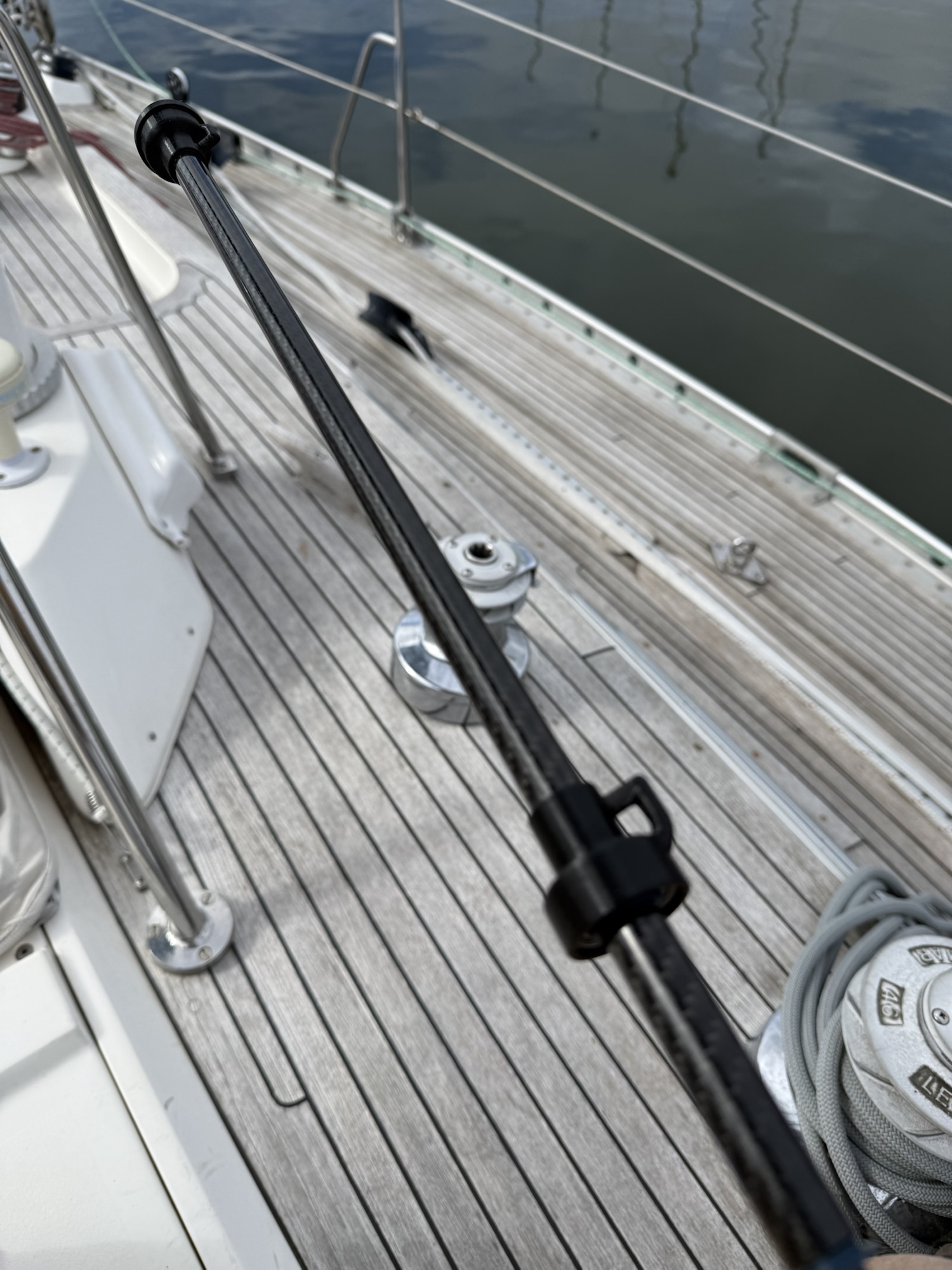
I was very pleased with the pigstick. It did the job beautifully. But as we left Cherbourg it seemed not to be turning so freely. Once out of the harbour, on the way home, I lowered it to see that was going on. It turned out that the lovely roller bearings that I’d thought were stainless only had stainless shells, and that the lower one, that can sit in water, had rusted up solid.
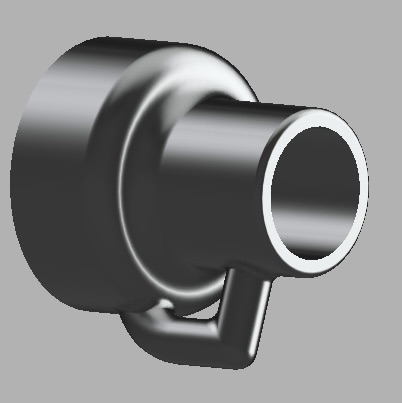
Mark 2 was clearly required. Shopping around I couldn’t find any suitable stainless needle roller bearings but could get some standard all stainless bearings – trouble is they were a fair bit larger in diameter, so I had to redesign the fittings a bit. I printed redesigned end caps for the outer carbon tube, that acts as the carrier for the burgee, with a larger cavity for the conventional bearings. It’s not as slick looking, but works perfectly and has now coped with a couple of weeks of use.
We’ve been members of Itchenor SC for about 15 years. We joined when we got involved in sailing XODs – wonderful Edwardian day boats that are raced very hard indeed. We’ve remained members partly because I’ve always planned to go back to sailing XODs when I get time, but also to support the place as it is the most extraordinary dinghy club. I’m used to places like the Hythe sailing club of my teenage years, or Wilsonian on the Medway from my 20s. These are basic places (Wilsonan didn’t even have mains electricity) with big dinghy parks and catering, bar and racing all run by the members. Wilsonian’s start line was a garden shed installed on a platform built on top of a WWII pill box. I may have helped build the shuttering and pour the concrete for part of the seawall by it.
Itchenor has a full time staff team, hotel standard en-suite rooms, if needed, lovely bar and excellent food. We were won over by the dayboat racing finishing in time to be back to the club for tea and (excellent) cake. It has a fleet of 6 or 7 RIBs, and three committee boats, the largest of which, Betivuka, is good sized 28′ launch, with excellent facilities.
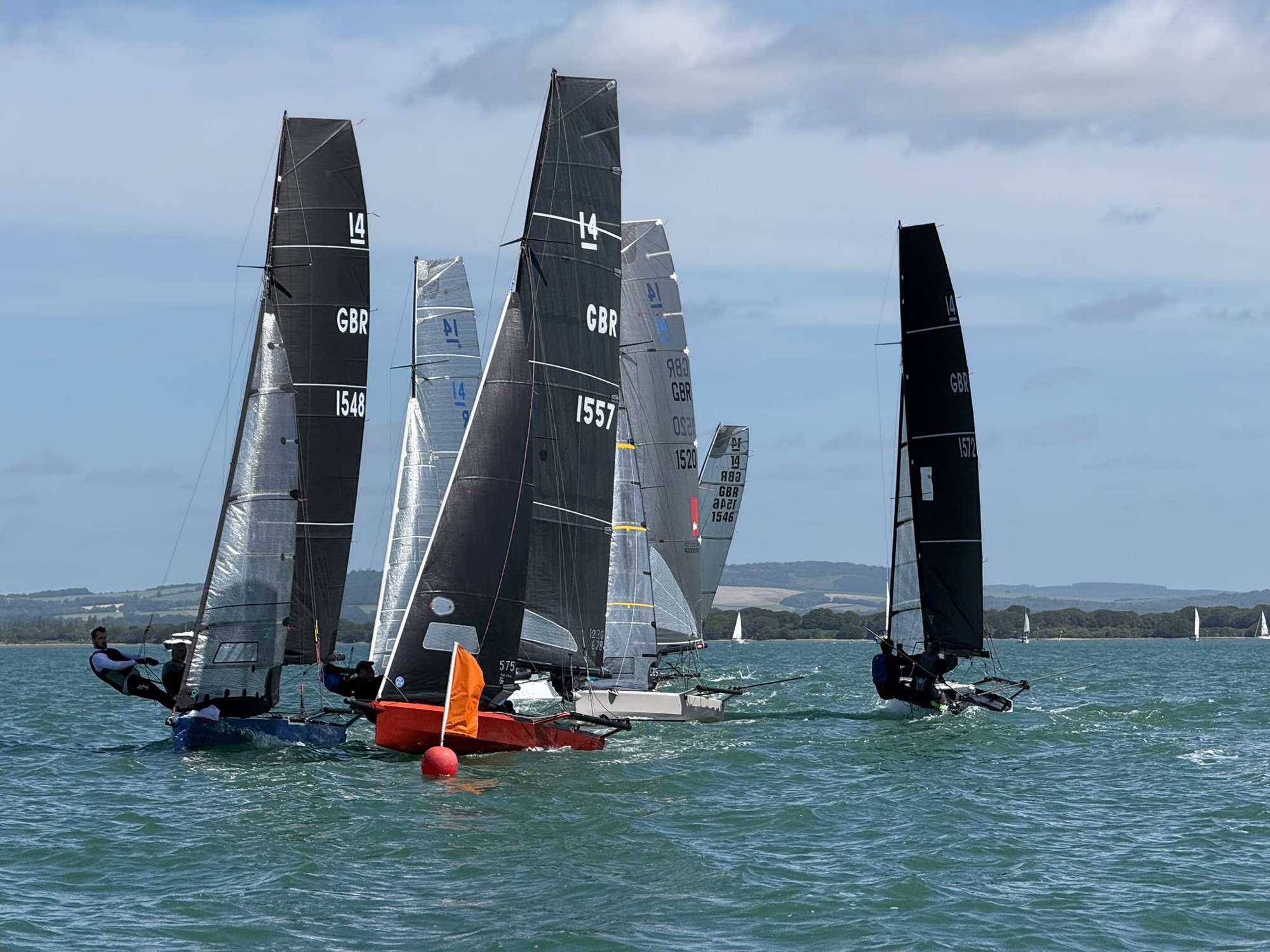
Whilst most of Itchenor is run by a very professional staff team, there are nonetheless on the water duties for members to run the racing operations – either on the committee boat or the RIBS. We try to get our duty days each year to align with a day when the 14s are racing out of the harbour – as I find it much more fun and the 14s can really stretch their legs on open water. The club, like many, has a number of class fleets, and no handicap racing. The International 14 is the highest performance boat in the club and they are fantastic machines. They are a development class, so any boat that meets a set of design parameters is class legal, resulting on a fair bit of variety. The boats have evolved very significantly over the near 100 years of the class – a modern 14 is a very low profile carbon skiff hull, with racks, twin trapeze, a carbon mast and retractable bowsprit that almost doubles the boat’s 14′ length. The rudder is a T foil that is actually used not for lift, but to hold the transom in the water off the wind. They can exceed 20kts off the wind. The club is home to one of the UK’s larger fleets, and includes a few internationally dominant sailors.
Mid June saw our duty weekend roll round. Sadly the racing was in the harbour as not enough boats had confirmed in time to commit the resources needed to race out of the harbour. Nonetheless it there was some great sailing, and I rather enjoyed looking after the mark laying for the fleet, and providing safety cover.
14s rounding the top mark – yes the mark needed a heavier sinker!
Saturday saw a westerly that allowed a windward leeward course from the Itchenor channel up past Hayling, and then a reach into the Emsworth channel; whilst Sunday saw a southwesterly that backed southerly during the first race, resulting in a hasty re-laying of the windward mark on the eastern edge of the East Head anchorage. The video above is from the second race with the repositioned top mark.
The harbour authorities have been cracking down on powerboat speed in the harbour – in many ways with good cause – but this has now extended to club safety boats. We may now only exceed the speed limit of 8kts if we believe someone is in trouble and in need of urgent assistance. I think that the huge problem with this is that with a fairly small number of boats in a fast fleet (like 10 Int 14s), that need a large course area, you just can’t stay close enough at 8kts (the speed limit) to even know if they are in trouble. I lost sight of one and only realised it had capsized when they’d recovered themselves and emerged from behind some moored craft. At 8kts you can’t keep up, or even open up the angles to keep them in sight as they navigate the harbour. 9 times out of 10 a 14 capsize is routine, and the last thing they want is you getting in the way, but as twin trapeze boats with no air pocket when inverted the risks of entrapment and drowning are very real. As a (very?) experienced safety boat cox I want to have good eyes on and be counting heads long before the 3 minutes post capsize that could mark the start of irreversible brain damage from hypoxia.
I appreciate the harbourmaster’s dilemma. Not many of the people doing their club duties have my experience – last year I had to help a different club’s safety boat recover a swamped capsized dinghy as they didn’t know how. But equally I felt very uncomfortable on the Saturday with a big course, where I couldn’t keep sight of what was going on. You might think that the solution is zonal safety boats each looking after a portion of the course. That would work but would have needed at least six safety boats for a 10 boat Int 14 fleet on Saturday. On Sunday there was a bit less breeze and with that and the wind angles the course area was smaller, which helped.
Even then, on Sunday I did break the speed limit. A Laser 2000, that was not part of the Itchenor fleet, had passed me with a father and two sub teen children on board. The boat looked like a sailing club rental boat, and wasn’t part of a fleet, just out for a lovely sail. Just after one of the last 14s rounded the top mark there was a gust that saw them overpowered as they hoisted their kite, and they went swimming. The Laser 2000 had their kite up too, and wasn’t able to depower fast enough either. Both were about 500m from me, and about the same distance apart. I got the safety boat up on the plane, checked for heads on the 14 (who were fine) and headed for the Laser 2000. They were Ok too, with the daughter not just with dry hair but also clutching a collection of water bottles and stuff that had floated out of the boat. She clearly hadn’t been put off! I stood by to windward and ultimately held their bowsprit to let the boat blow out to leeward once they’d got it righted but hadn’t yet got back on board. The father thanked me and said he’d been very pleased to see me there.
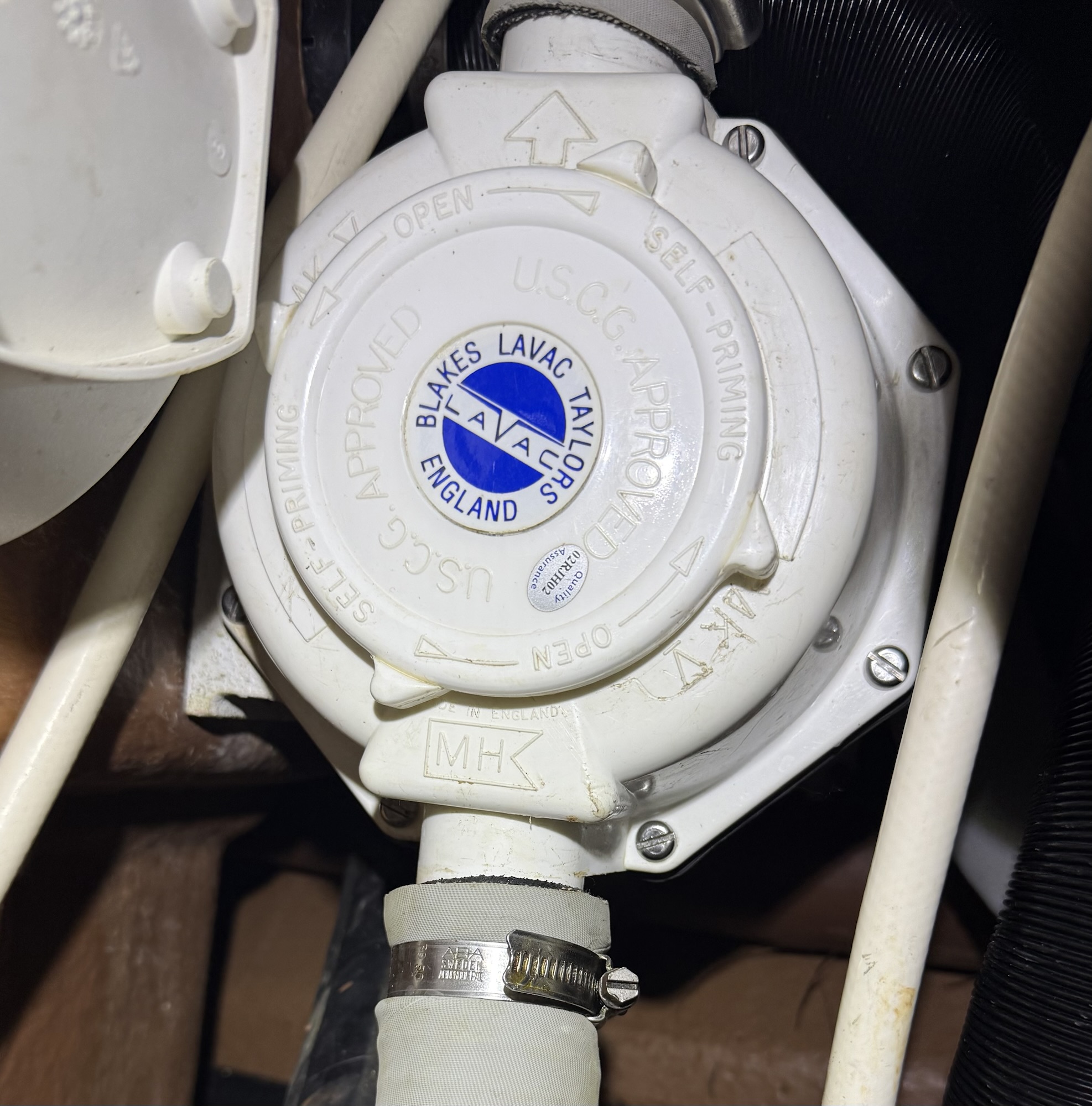
Trouper has rather clever Blakes Lavac toilets. Unlike the more common Jabsco marine toilets there is no change over valve between flush and rinse. The Lavac design simply has a large diaphragm pump on the discharge side, a high loop with a small vent on the inlet side and seals under the list and seat. When the pump runs it creates a vacuum in the bowl and draws seawater in to flush it. When the pump stops the vent breaks the seal after a little while and the lid can be raised. The beauty is in the simplicity – and is best appreciated by those who’ve tried to strip and rebuild the Jabsco ones at sea: they are not only full of small parts, including springs, but the pump itself is notorious for cracking at its base and they are prone to clogging, due to some small openings.
Trouper not only has two of these Lavacs, adding a little redundancy, as well as ensuring that at sea one is always on the downhill side at sea, but they are also electrically operated.
I rebuilt the aft one about 8 years ago, and the forward one’s motor failed in 2022. When the forward one failed I also rebuilt it with new valves and diaphragm together with repainting the aluminium body. It was looking as though I was going to have to replace the pump with the newer design they now supply as the parts are no longer available. This was going to be quite expensive and would need some new brackets and reorganised plumbing to accommodate it as they weren’t the same shape as the old ones. In desperation I looked hard at the old motor unit and spotted what turned out to be a Bosch part code stamped into its body. The previous owner had told me that he’d installed that motor and it had never seemed quite right to him as it operated very slowly – he’d even wondered if it was a mislabelled 24v version. Armed with Bosch part code I went internet shopping: it turned out to be the windscreen wiper motor and gearbox from a 1990 vintage Mercedes Sprinter van. I ordered a new one for about £40 (the replacement pump, that wouldn’t fit, was well over £250) and it fitted perfectly. When I came to wire it up I discovered that there are 3 positive terminals and one negative. They are for intermittent, slow and fast wipe settings. It turns out the old one had been connected to the slow wipe setting!
When we were in France at the start of the month Kathryn had spotted a dribble on the aft head hose that turned out to be from the pump diaphragm leaking. So last weekend, in sweltering heat, of course, I stripped and rebuilt the pump. When I first bought the boat I’d tried doing this in situ under the after heads sink working through a tiny cupboard door. It took all day and didn’t last long as I’d not got it all together straight, which resulted in the rebuild about 8 years ago. I’d been driven to this as I was worried about reinstalling the pump, but when I rebuilt it I did take it out and discovered how to reinstall it easily. Trouper’s heads have a shower head and hose that is stowed in a hole in the counter top of the sink. If you pass a loop of sting through that you can use that to support the bit of the pump you can’t reach in place chest you put the fixing bolts in place. After that it’s two hoses and an electrical plug.
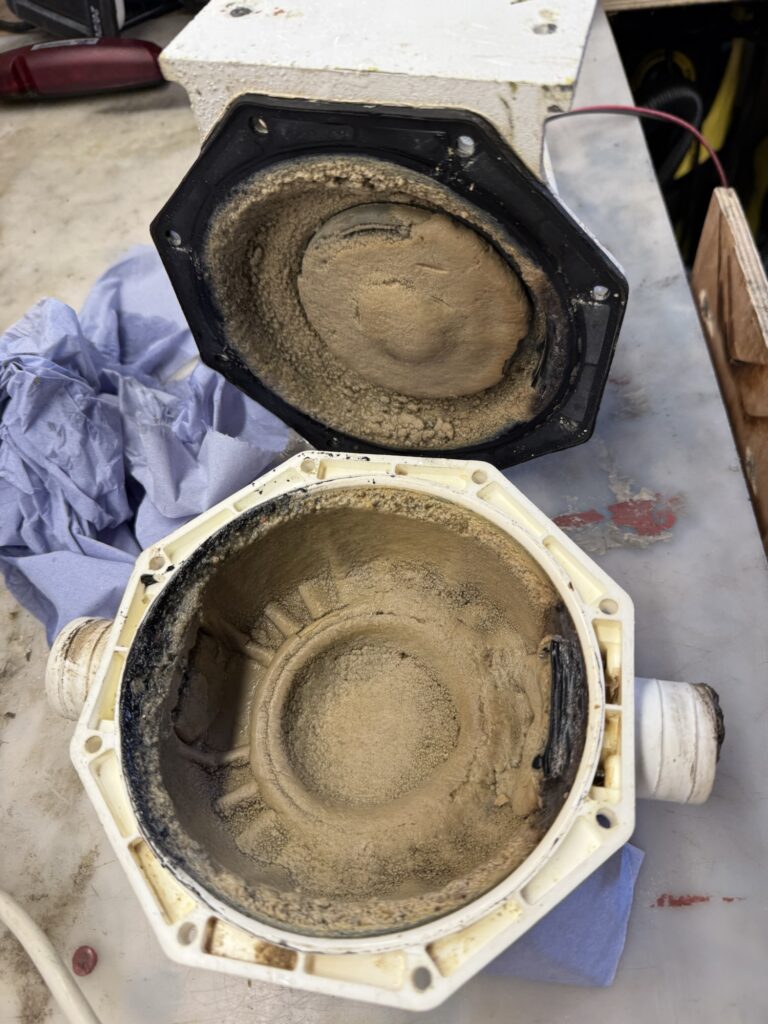
So this time I took the pump out with some confidence (having flushed it with a lot of seawater first) and took it off to the bench in my workshop. Once apart it needed quite a clean – there’s an unfortunate reaction between salt water and urine that forms a crystalline deposit, and 8 years use had created a fair bit of that.
Inside of the pump body before cleaning.
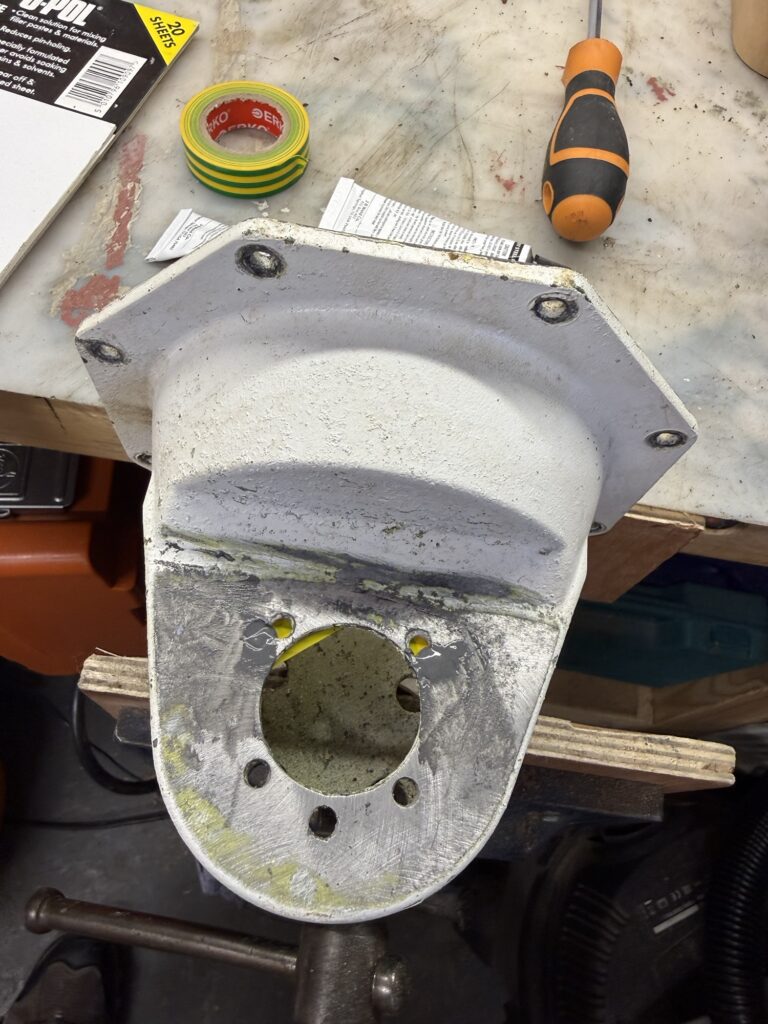
The paint from 8 years ago was in quite good condition (the metal painted bit should be on the dry side of the diaphragm and hold the motor assembly in place) so I just repainted a couple of patches that were most in need, and filled some corrosion damage with JB Weld.
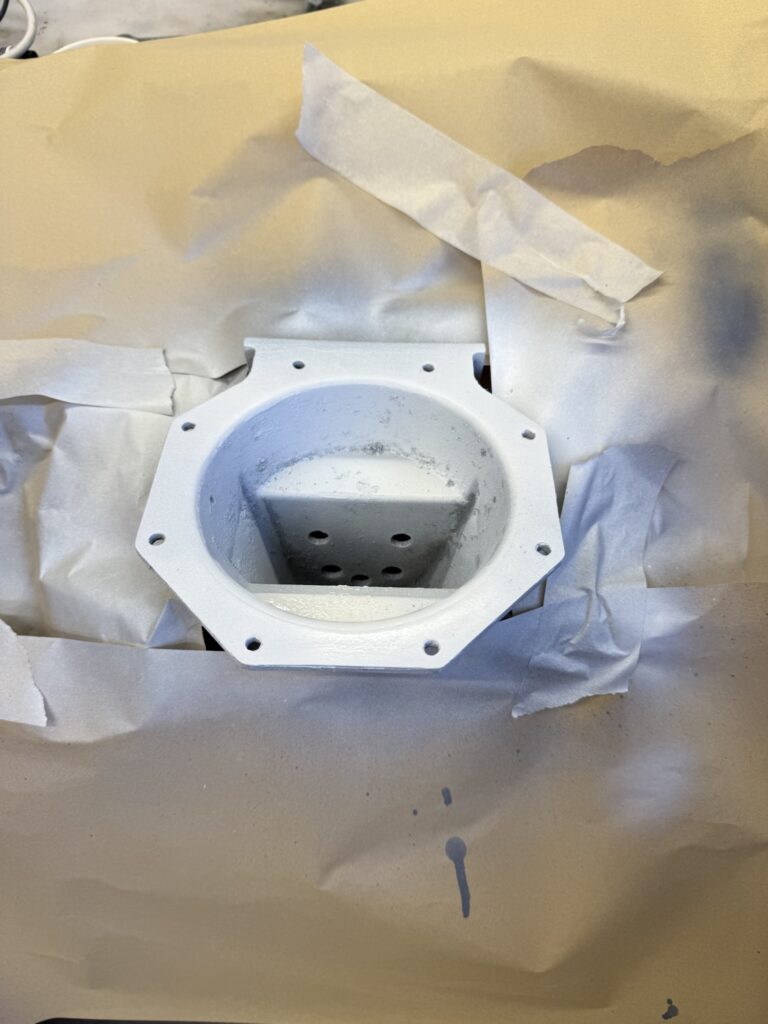
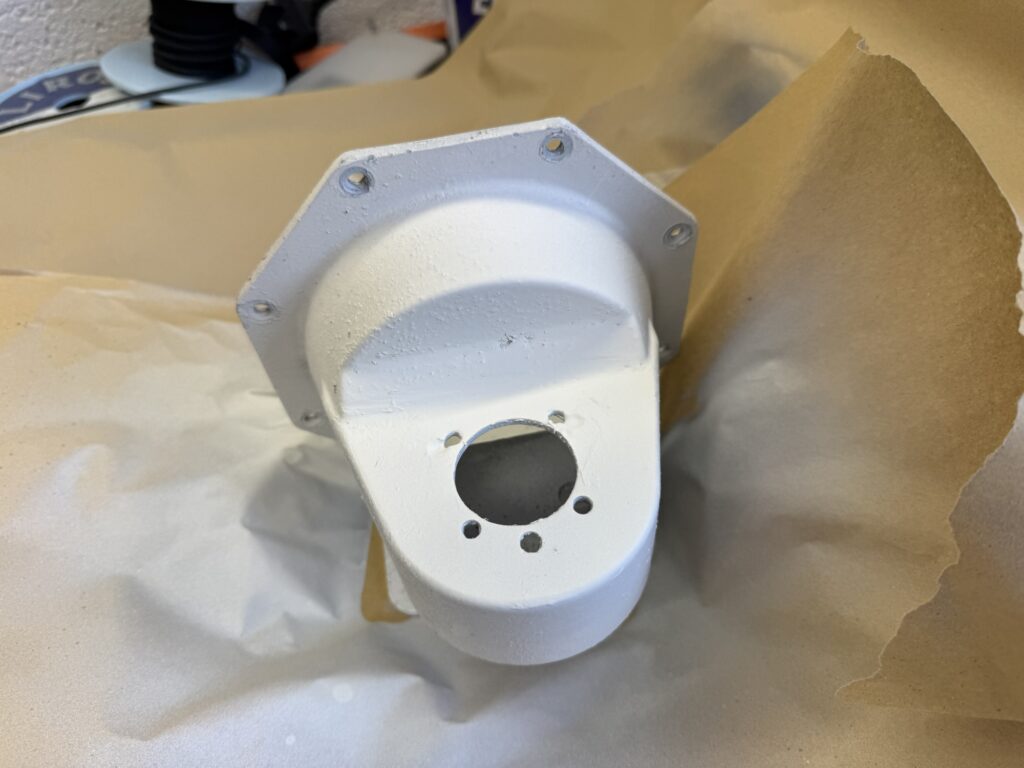
Ground back awaiting primingTop coat going on Finished job, before remounting the motor.
I primed it with two coats of an acid etch primer, and then gave it three coats of top coat – with the last two either side of a much needed early evening shower.
On Sunday morning I reassembled it with a new diaphragm and valves and reinstalled it. The reinstallation was a bit fiddlier than I hoped as I needed to tidy up the end of the inlet hose which was a bit battered. I trimmed about 20mm off it, and then removed the spiral steel reinforcement for about 30 mm to make it soft enough to mate on the pump and clamp tight.
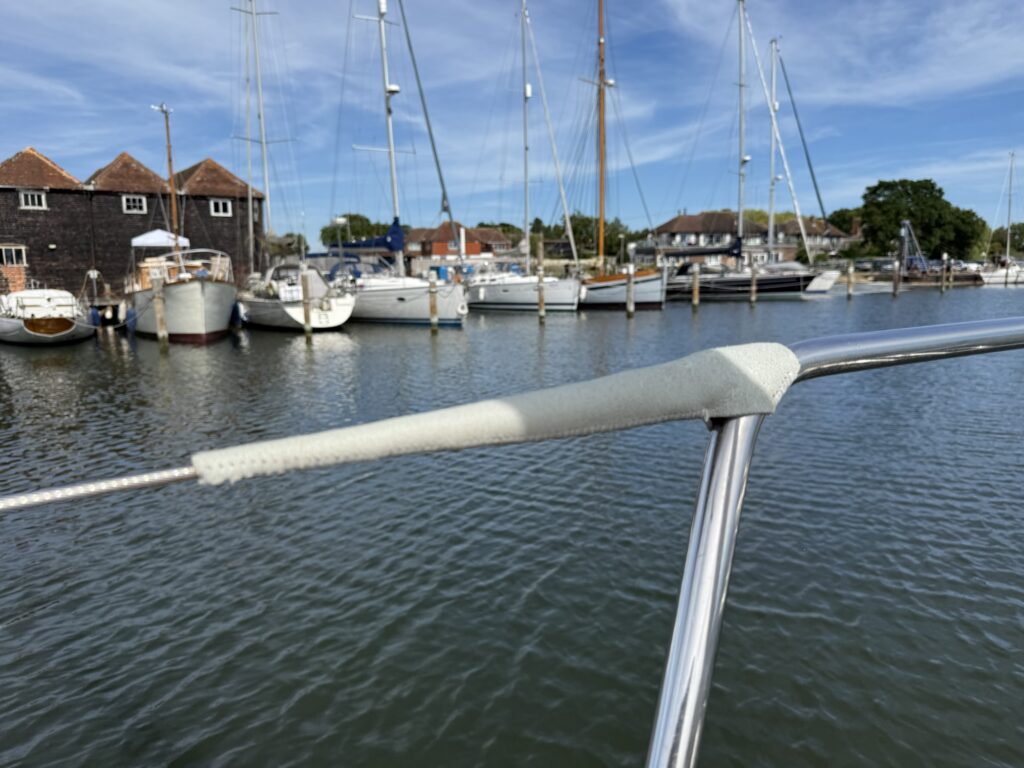
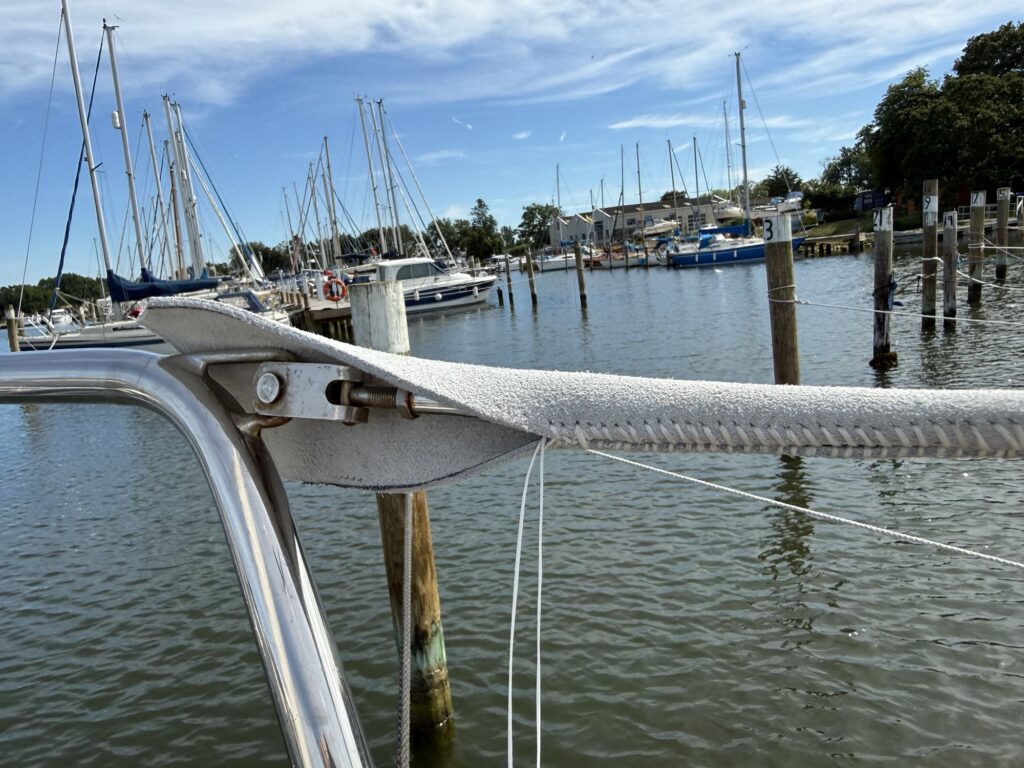
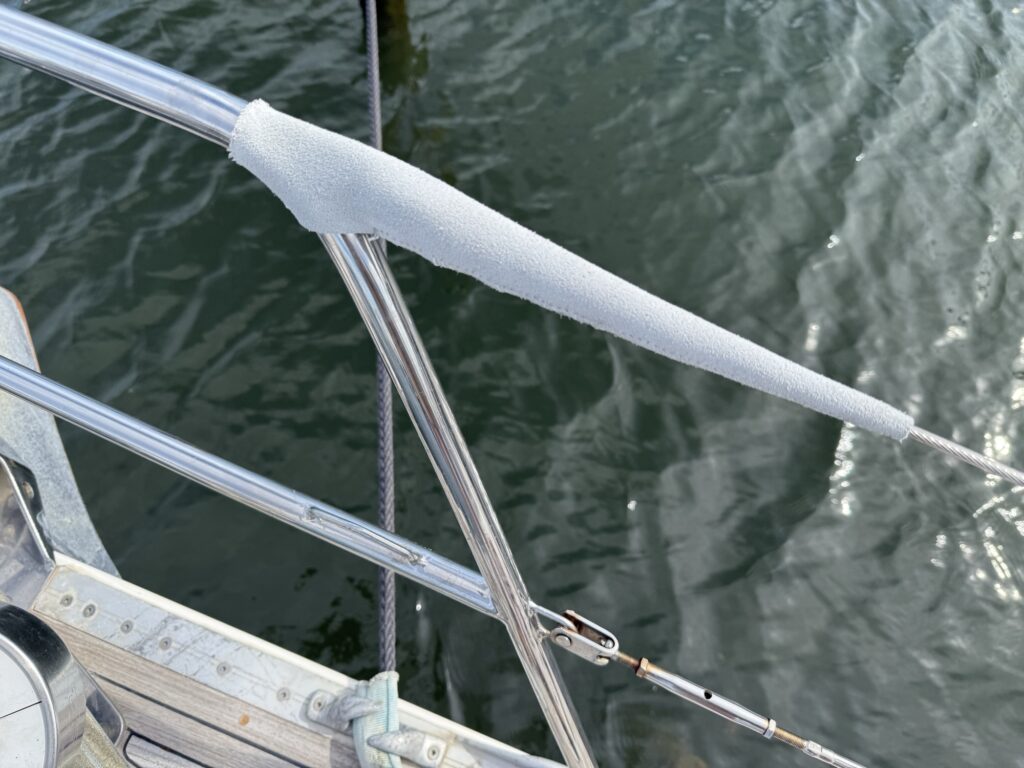
I also finished fitting the new leather boot to the lifeline to protect the headsail, that I’d started in Cherbourg.
The one I did in cherbourgWork in progress stitching it in placeFinished job.
I did a little, very much needed, workshop tidying too, and assembled and tested Mk2 of the Pig Stick and fitted a new brighter B&G 2020 HV Mast display. All in all it felt like a very productive 36 hours at the boat.
It was all looking so good – we just got onto the platform at Waterloo on time to catch the 1705 to Southampton Airport Parkway and on to Universals where we had a table booked for dinner at Riverside Social at 1945. We put our bags in the rack and sat down, just in time for the guard to announce that a person had just been hit by a train near Vauxhall and the power was off all lines out of Waterloo to allow the emergency services access. Someone else and their family was clearly having a much worse Friday evening, but it left us replanning.
We decided to head back to the flat and drive to the yard and then we could relocate the car to Birdham on Saturday. We were even only 20 minutes late for dinner. Saturday saw us take the morning tide round to Royal Clarence in Portsmouth harbour, where we get a free berth as it is the sister marina of Birdham. Once Trouper was tied up we took an taxi back to Universals to collect the car.
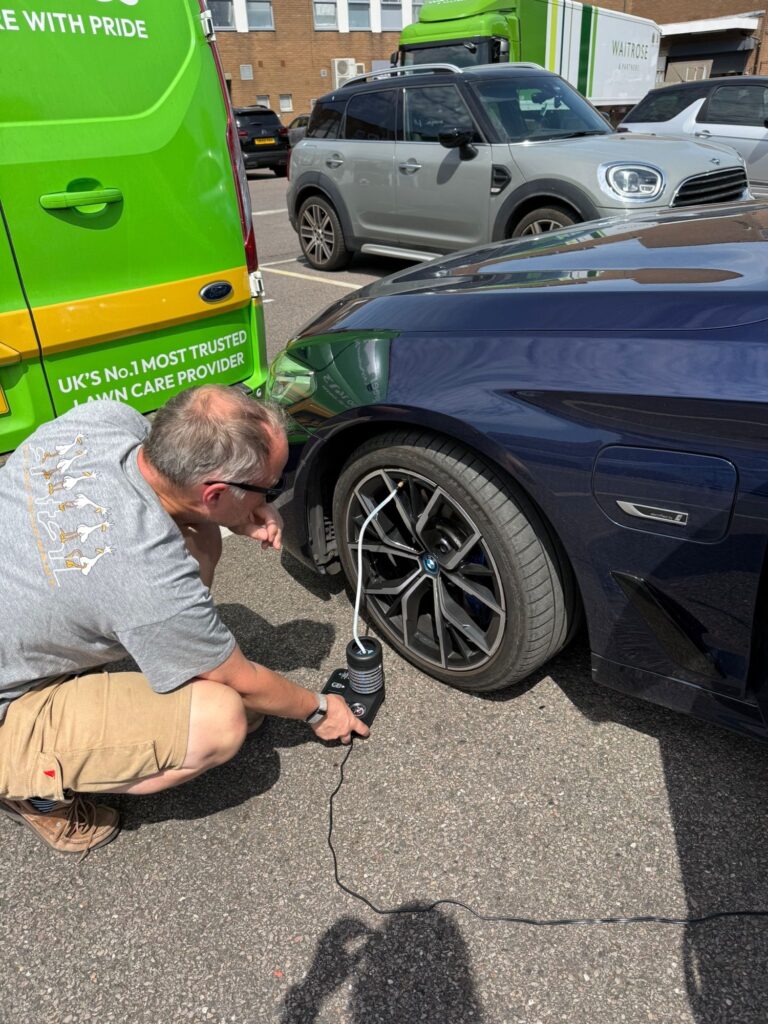
From there we headed to Gosport and Waitrose to provision for the trip to France we had planned. Unfortunately as we left the car park I realised that we had a flat front nearside tyre. I used the BMW supplied temporary repair kit to get the car drivable, dropped Kathryn at the boat, and headed to Birdham to leave the car, and where Graham was going to pick me up and take me back to Gosport. The reason for the trip was to deliver Graham and his partner, and a load of stuff, to Cherbourg to join her eldest son’s new boat on its delivery to Valetta via Lisbon.
Temporary tyre repair
Saturday evening saw us have dinner in the Marina with another friend who lives on the Hamble and we left for Cherbourg early on Sunday morning. It was a motor to start with and then the wind built with the second half of the trip hard on the wind with 20kts over the deck, and a reef in the main and a few rolls tucked away on the genoa. We got in early evening to be met on the pontoon by the delivery crew and proud new boat owner. We went for an excellent dinner in the yacht club on top of the marina office. I’d never been before as it always looked closed from the outside. The furniture was a bit dilapidated with torn covers on chairs, but the food was excellent and there was a super hot charcoal grill that delivered me some fantastic lamb cutlets.
The new boat was in Cherbourg for a 1000nm service by the Nautor Swan Global Service team from Hamble, who’d been working on Trouper the week before. A couple of minor problems had been found during the delivery from Finland, and the rig was due a check. They were due on Tuesday.
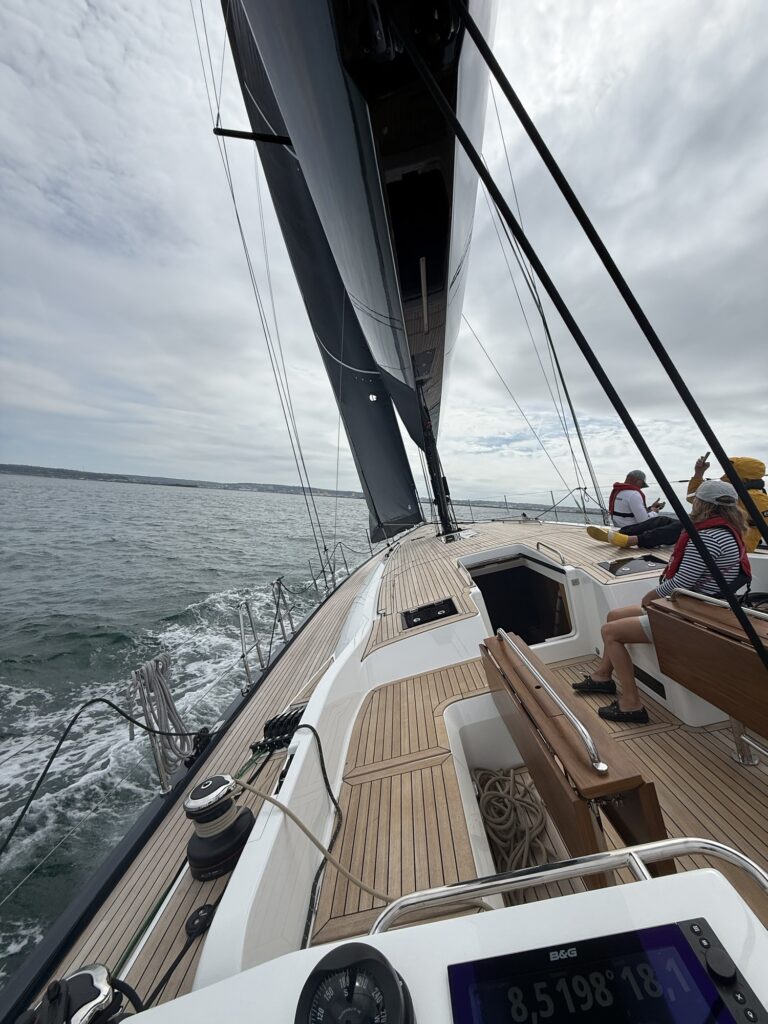
Monday saw fair weather, although Kathryn who’d just finished a course of antibiotics for a chest infection was really quite unwell and stayed in bed all day. The rest of us took the new boat, a Swan 51, out for a couple of hours for a quick sail. It’s a beast – and effortlessly quick, but huge.
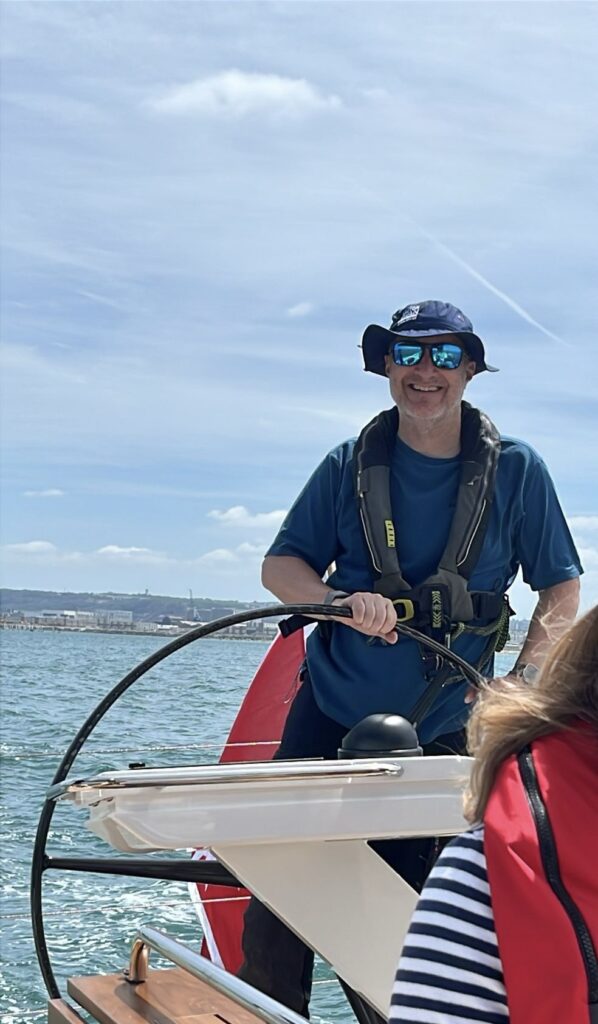
Big grin whilst having a driveSwan 51 Deck
Tuesday saw the weather turn with drizzle and over 20kts of breeze. By the time I was heading out for Croissants at half past eight the Swan team were already most of the way through the rig check with one of the team up the rig. Later in the day they were also able to fix the nagging electronics issue that had put the bow and stern thruster out of action – much to the relief of the delivery skipper. I was really impressed by him – he runs a sailing school in Montenegro, and does a few new boat deliveries every year. He and I had a bit of a laugh on Monday when we met heading for the same rope in anticipation of the same possible problem (that never came). He was saying that he wants to come back to the Channel area to cruise as it is unfamiliar ground for him but looks really interesting and demanding. He said, much to my entertainment, that you can have too much sailing in hot weather with no tide. He’s got my details and I’ll be happy to offer him what advice I can if he does come back.
The Swan guys also had a look at our dyneema backstay as it seemed to have stretched a bit – it’s due to to be replaced with new rod once we’re back in the UK, but in the meantime we do need to get back home! They checked the splices, which seem secure and I then wound the bottle screw so that we could get some tension as we’d hit the limit of the backstay hydraulic ram’s range.
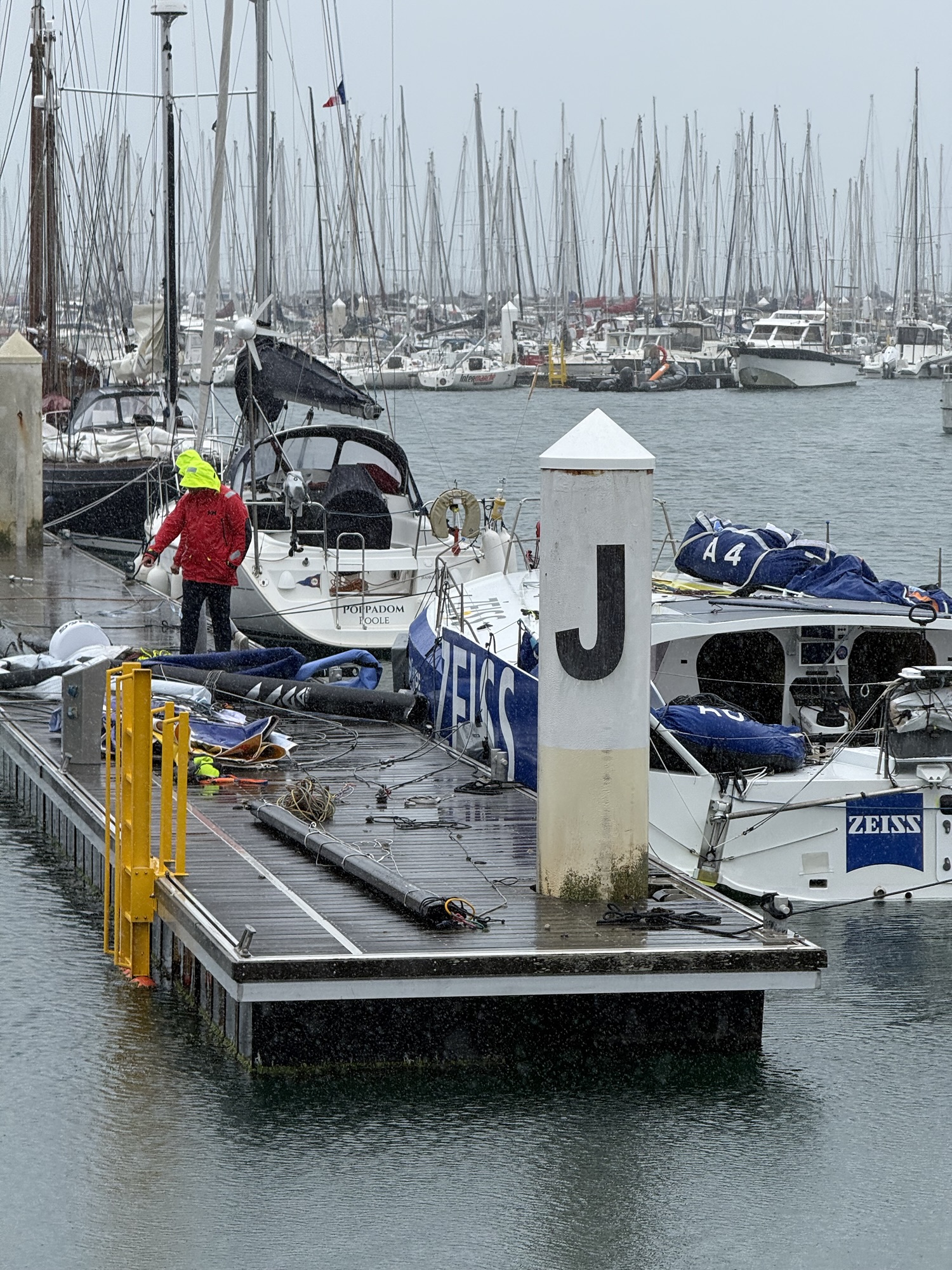
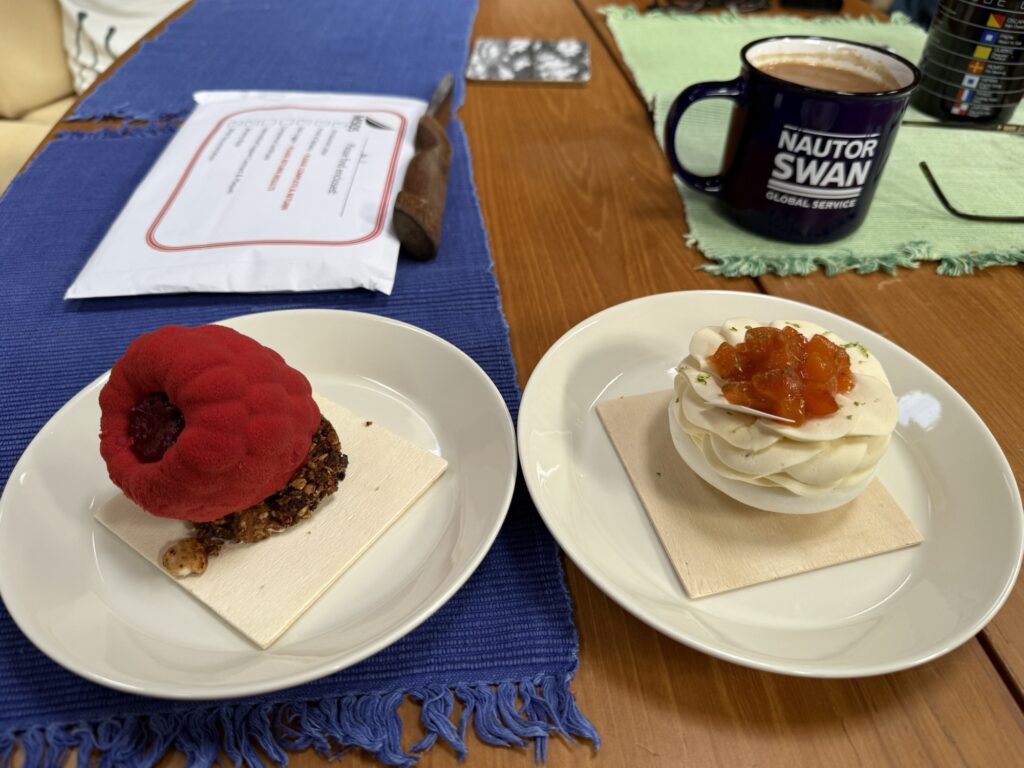
On Wednesday and Thursday we were very definitely weathered in – although the local sailing school was still taking out fleets of 10 year olds in Oppies. The harbour steadily filled with broken boats: a Class 40 race took a bit of a pounding from the weather. We took it easy, did some boat chores, a Carrefour run, and I reworked this Website. Pâtisserie might have been consumed.
Excellent Pâtisserie
One of the boat chores was making up new leather covers for the lifeline bottle-screws where they join the pulpit at the bows. These protect the headsails from being damaged by the sharp edges. I cut two but only stitched one in place before the rain returned – the other is next weekend’s job.
Friday saw a weather window for both crews. The new Swan left at about 0200 French time for Roscoff, going north of Alderney and tacking back just off the Casquettes TSS. They got into Roscoff at about 1800, having motor sailed. We left at 1000 French time and made Chichester at about 2000 UK time after an uneventful passage also motor sailed, in an about 12-16kts of SWly. It wasn’t quite enough breeze to keep up a decent passage speed under sail… If we had the top down furling asymmetric that’s on my wish list it would be a different story. We steered 020 from the Cherbourg breakwater until past Bembridge, when I thought we were a bit too far to the East for the west going tide to sweep us home.
By 2030 we were on the Itchenor walk ashore pontoon, and could see the wall of cloud as the next weather system rolled in. Saturday saw us go for a short walk along the harbour path before being discouraged by the rain and returning to our books, and this website. It was properly windy. We saw over 40kts in the gusts and the Nab reported over 50kts. We elected to stay where we were given the weather, as trying to get Trouper into Birdham’s lock, which is a bit of a squeeze at the best of times, seemed like an unnecessary risk with huge gusts beam on – especially once the lovely Sara, the duty lock keeper, had offered to come in early for us on Sunday. She very kindly came in at 0530 so we could lock in an hour after HW. There wasn’t a lot of water under us, and I felt vindicated in my rule of thumb of not trying to get in after HW+1, but we were secure on our berth by 0550 and back to bed for 90 minutes.
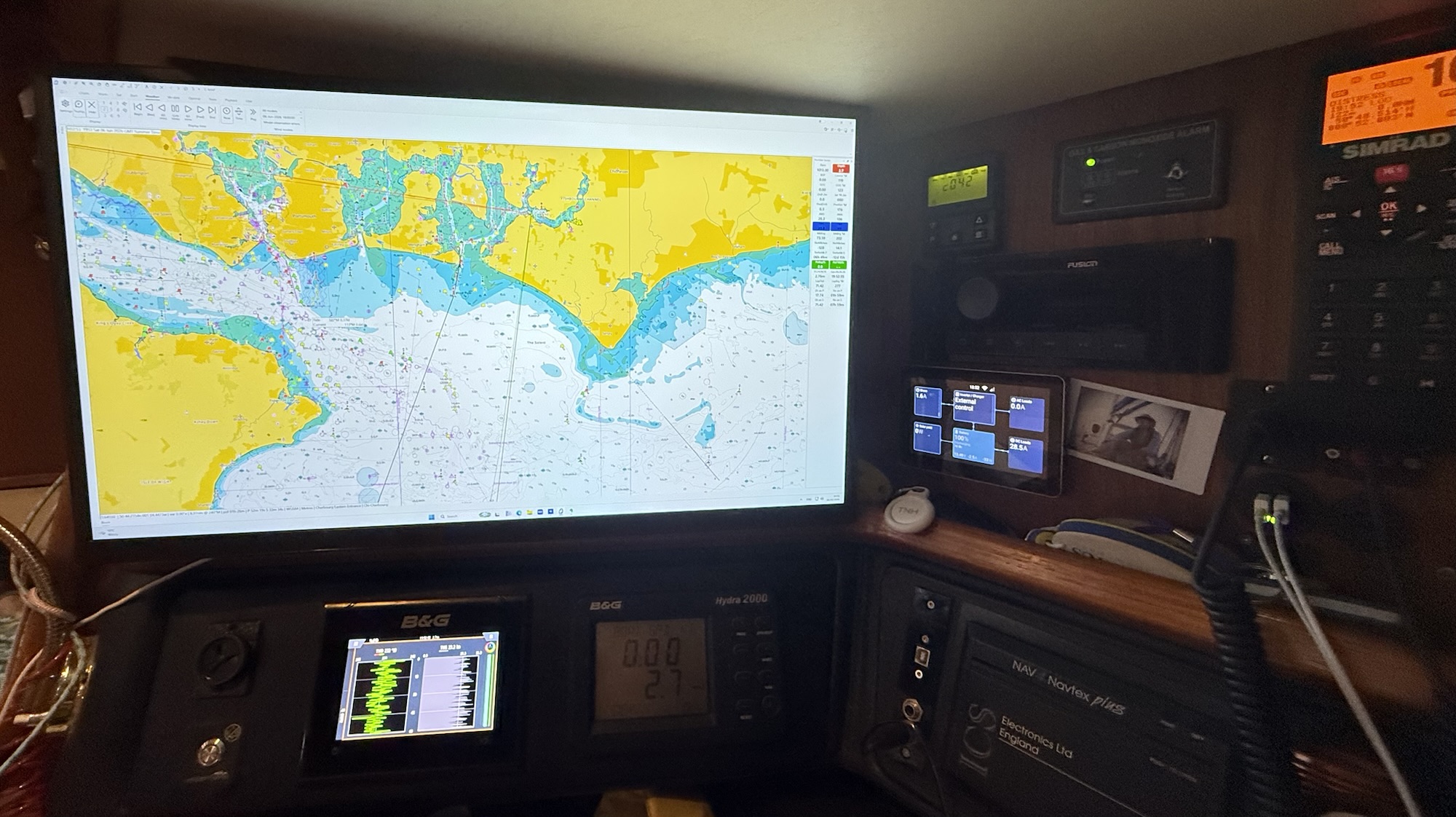
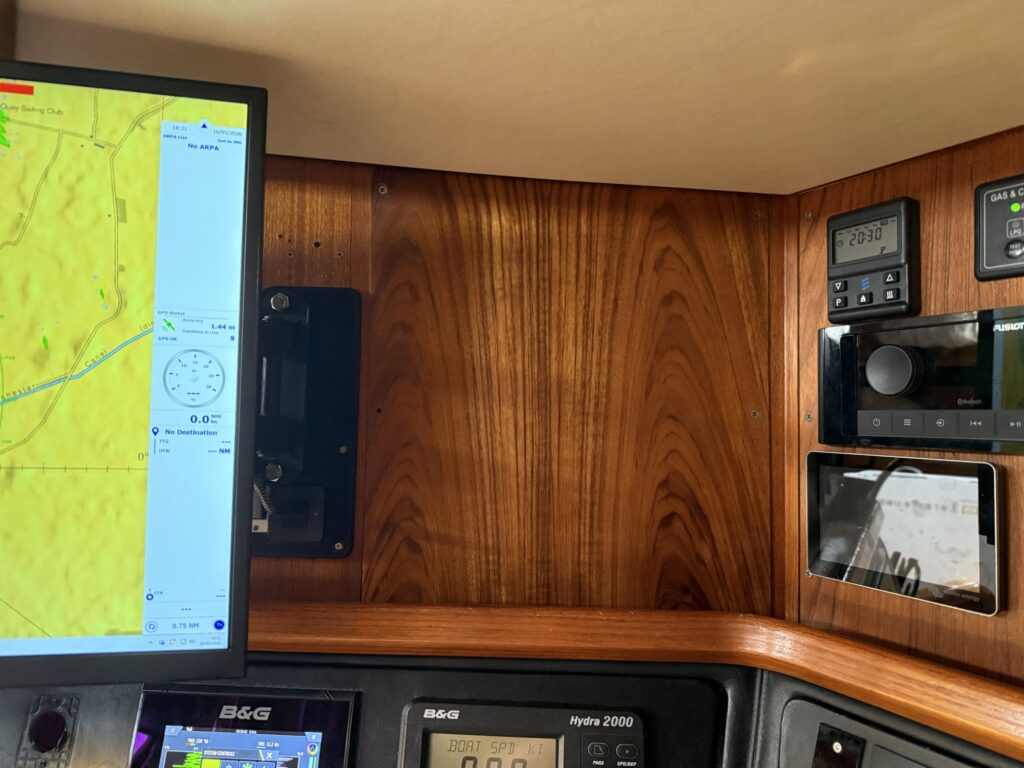
I fitted a new larger computer display to support the new radar and because the new C-Map Reveal X charting in Expedition (which is excellent) now supports 4K monitors. Removing the old radar display had left a hole in the nav station bulkhead that I had to make and veneer a new panel to fill. I was quite pleased with the results, although I had to move the radio handset to make room for the monitor.
New panel, where the radar was.
I’ve also acquired a Victron 4LTE device on ebay. It’s now installed but not working correctly yet but it will establish a always on network connection through the mobile network allowing the Victron monitoring data to be available even when the boat is shut down. It’s handy for monitoring the batteries, but I plan to add an interface to let it monitor the bilge pump and bilge alarm so it will be able to alert me if something goes wrong whilst we’re away.
The Victron Cerbo GX is proving to be a very powerful and flexible system – I simply bought it as part of the lithium battery install a few years ago (mainly for it’s lovely display, if I’m honest) but it’s capable of doing far more than I realised. It is now also our SignalK Server and will run NodeRed allowing low code automation.
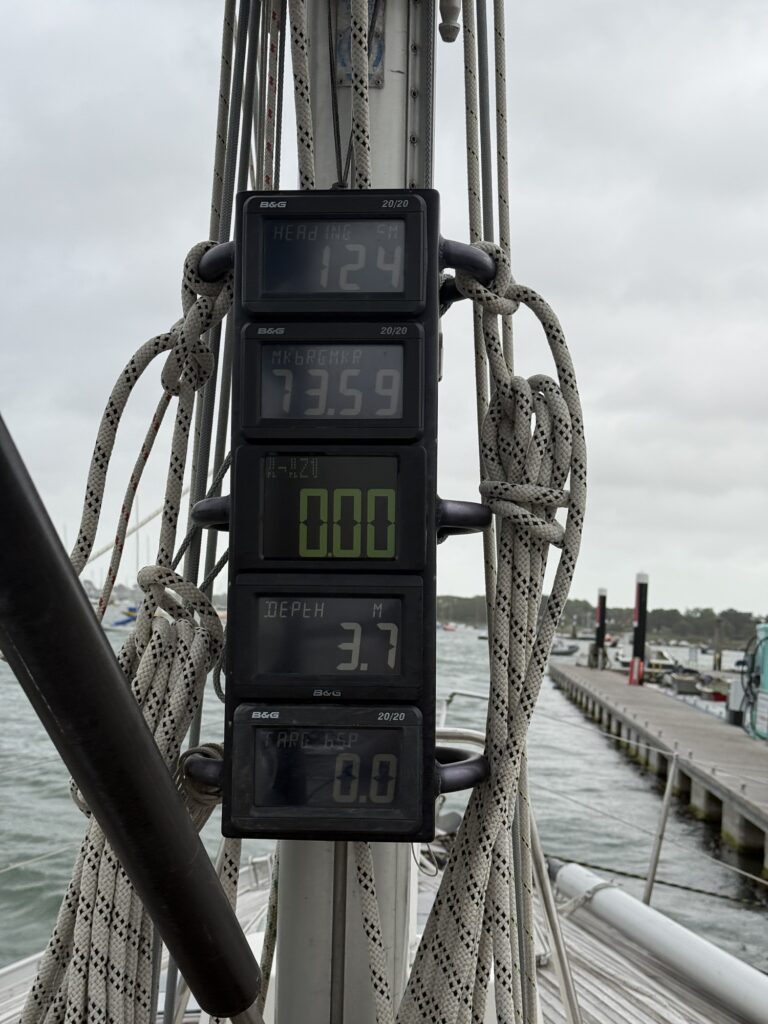
The final prep job was to fit a new display to the instrument pod on the back of the mast that has 5 B&G 2020 displays. I’ve slowly been acquiring used newer models (that are still Fastnet and not N2K) to replace the ones that are there on eBay. The later models are a bit brighter and have better waterproofing – every couple of years I have to dismantle the current ones and put new desiccant bags in them. Though the new ones aren’t in yet (I’ve got two to fit) because they need a slightly bigger hole and different fixing holes, so I need to modify the pod. My standing ebay search had spotted an A&T 2030 display, which I’d snapped up for a couple of hundred quid. These are great quality after market displays made in Lymington by a fantastic little firm: A&T Instruments. The display name comes from the fact that it fits on a 2020 cut out (and will support either fixing pattern that B&G have used) but the characters on the display are the size of those the larger B&G 3030. It works brilliantly and is so much clearer than the other displays that I went to see how much four more new ones would be: at just under £2000 each I’ll stick with the eBay search. I do hope that a few people will have bought these, and A&T’s cockpit displays, to keep old B&G instrument systems going that are now being replaced and that the A&T displays might turn up on eBay.
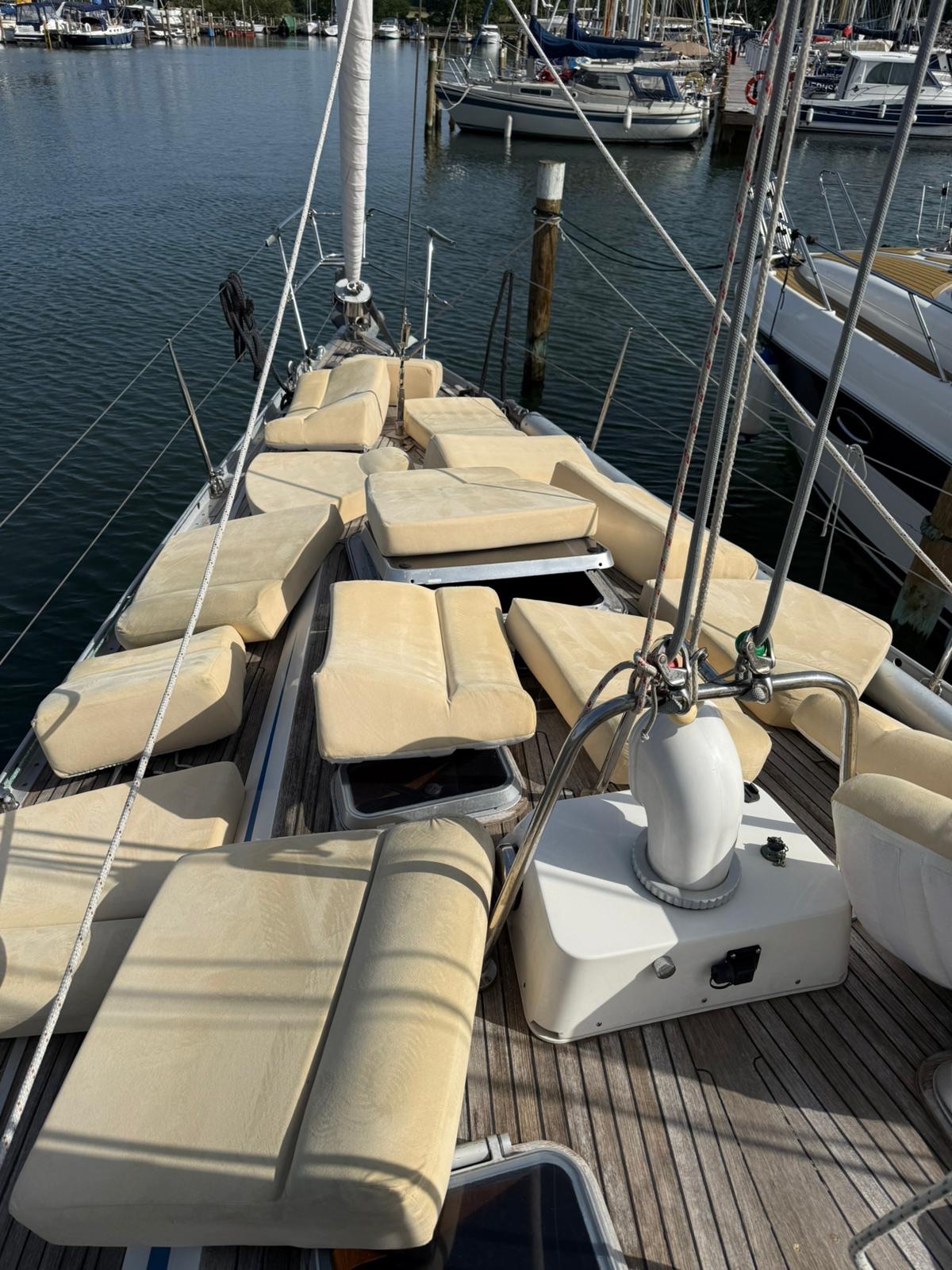
Before we could get away for the late may Bank holiday there was a pile of work to be done: the usual spring clean below and cleaning all the upholstery.
I was also able to finally fix the forward bunk hinges. One had failed on each side and Nautor had supplied some replacements over the winter. Sadly they were close but not quite the same with two of the screw holes slghtly smaller and with a different spacing. These screwed into a tapped 5mm thick stainless plate that is in turn bolted to the bunk frame and acts as a spacer. I’d spoken to Rob, the local marine fabricator, about making up some new plates but he had a better and cheaper plan: he’d simply weld up the existing holes and then redrill and tap the plate. He promised me I’d not be able to tell where the old holes were. Suffice it to say he was right and they allowed me to put it all back together.
Once Trouper was back afloat with a working propeller I was keen to get her off the mooring and to actually start to make use of her this year.
Before we could leave on the Saturday there was a chunk of last minute work to be done that I’ve described in Last minute maintenance and New Displays.
That filled most of Saturday but we did manage to creep out into the Harbour on the evening tide after dinner and spend the night at anchor in Thorney Channel – one of my favourite spots in the harbour.
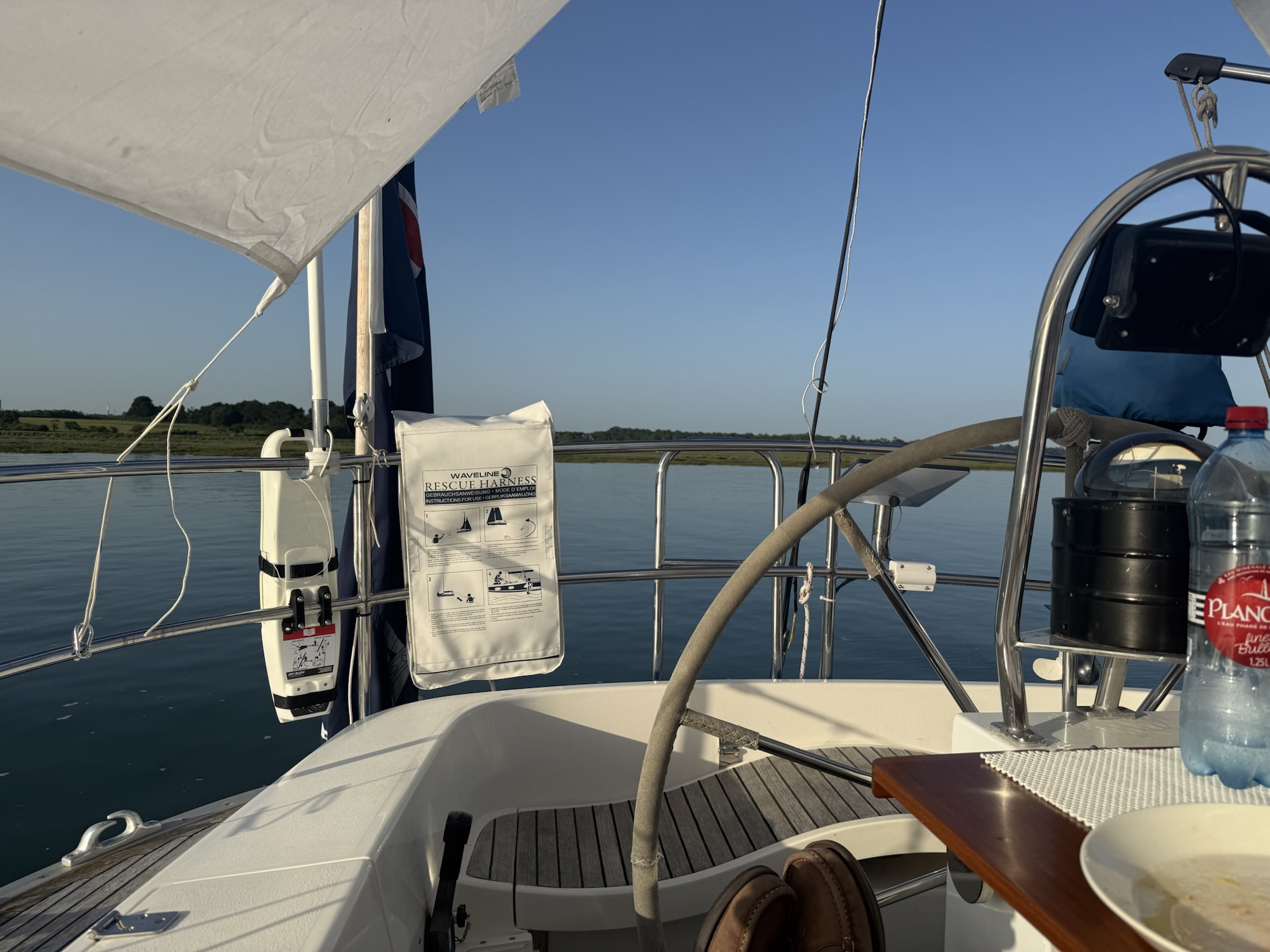
On Sunday we left in the morning, after stopping for a chat with our friend Graham who’d anchored his Swan 36 at East Head for the night. We then drifted and motored to the Beaulieu river when we picked up a mooring, put up the sun awning and set about testing the theory that RCC members get upto three nights free on a visitors buoy. In the morning the harbour master turned up in his dory and confirmed that it was true. Overnight this guy hauled out next to us – and snored quite badly.
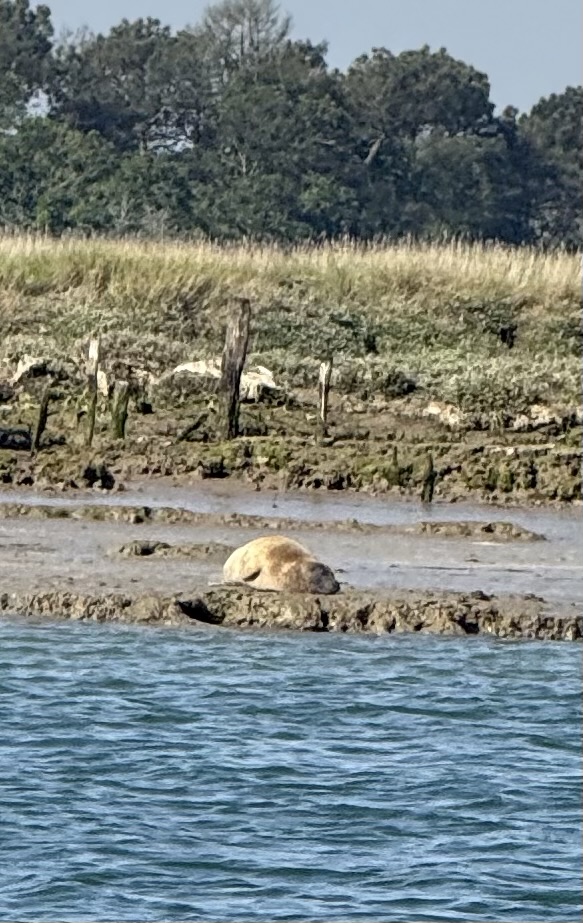
Seal
We left the Beaulieu River late Monday morning and popped round the corner to Universal Marina on the Hamble where we left Trouper for the rest of the week with Nautor Swan for them to finish the rig work from the previous winter. They fitted the new burgee crane allowing us to fly our RCC burgee from the truck (see Overengineering a pig stick for more on this) and their sub contractor replaced the underlength D1s and V1s from last winter. Whilst she was there we agreed to switch out the new dyneema backstay for a rod one. It’s a long story but in the end we all agreed that rod was a better option and they’ve been very good about the cost. We also agreed to revert to the wire babystay, and the refund for that and the backstay covers almost all the cost of the rod backstay. I might swap out the babystay myself later, as a more flexible material would help with stowing it when it is not in use. They’ll fit the new backstay whilst the boat on its berth at Birdham. Overall they’ve been very good to deal with.